

The drinking habits have been changing, and wines are being drunk earlier and earlier. And especially the whites have been difficult with the premox problems being strongly present until the change of stoppers (Diam) in 2013 and 2014.
Much is also here influenced by accessibility, as it is very difficult to get wines that are older than 10 years … if you don’t have a well-equipped cellar yourself.
That being said … this is what the Winehog users on Instagram say…
The result of my somewhat unacademic questionnaire is a bit intriguing
Around 50% of the wines are consumed within the first 5 years. Interestingly the same as for the reds.
50% is drunk when the wine is between 5 and 10 years. a higher share than for the reds.
And finally, only 2% is consumed when the wine is 15 years old … or even older.
The result is a bit intriguing, as a lot of changes have been seen within the last 15 years.
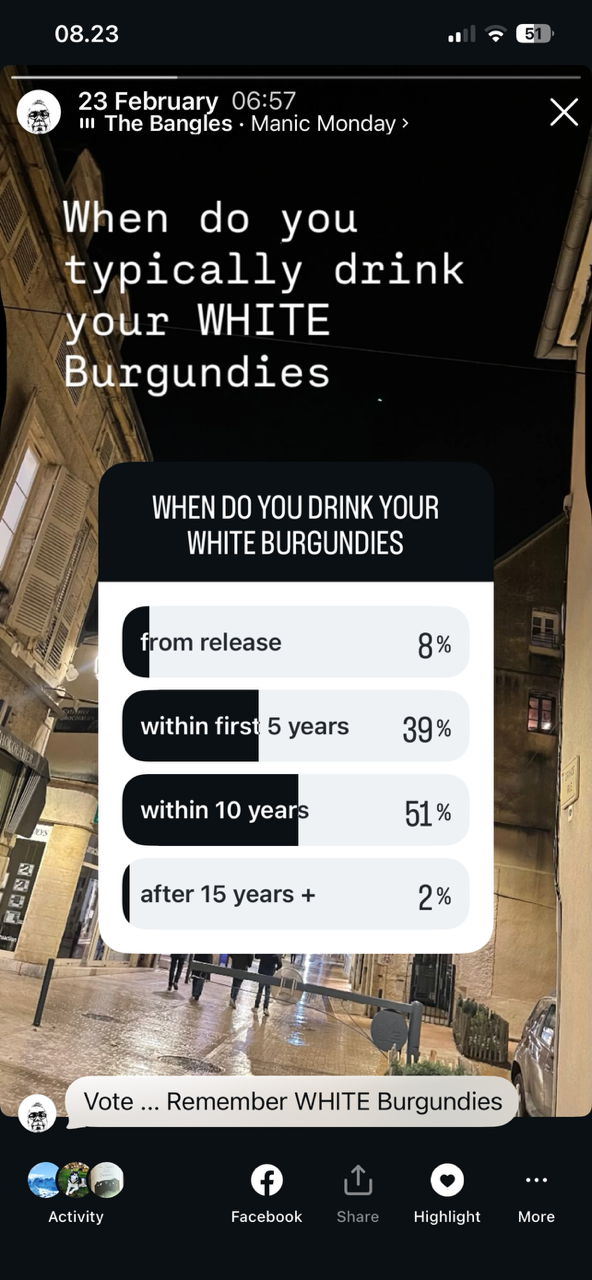
There are always issues with doing these kinds of questionnaires… and as it is informal, we will live with these issues.
I do want to make some personal conclusions … that could induce some debate at the tasting table.
Results … comment
With my more than 30 years of experience in analytics and research … and more than this in enjoying Burgundies … I have the following comments!
- Only a very small share is kept to what I would call maturity … 15 years + is perhaps stretching it, given the premox issues ruling a lot of the behaviour up until 2013. In fact, the premox problem will influence the cellaring behaviour for many years to come.
- 50% of the wines are drunk young, as for the reds – this is not alarmingly bad actually.
- In the ready-to-give stage (5-10 years), we have 50% that will get a wine with some ageing and maturity … this does, however, cover a large range as some wines a Diam wines and others are with traditional cork stoppers.
Implications
It is pretty clear that a lot of whites are being drunk young or even very young … and consequently quite some whites too early … depending on reduction and sulpher level.
The maturity level of a 10-year-old white Burgundy can range from fresh and even youthful to quite heavily oxidised. And somehow I can’t blame people for drinking the whites young, as it requires quite some knowledge about timing for the introduction of Diam, to be on reasonably safe ground.
Restaurants typically have even less older white wines … say before vintage 2018 … and this does reduce your options also for the whites.
This has reduced the knowledge and insights into mature White Burgundies and the true delights you can find in these 15-year-old+ wines.
As the survey shows, almost no one is drinking mature whites anymore, and to be honest, I am not sure that an old wine with Diam will give you full complexity when it is 15+ years.
We need to do some more work “documenting” how white Burgundies age under a Diam stopper.
And then we need to find a way to find a better balance in the young wines – the first 50% – to get the reduction and sulpher reduced in the wines that will anyhow not be aged for 5, 10 or 15 years.
On this, a rather depressing fact … very few people drink truly matured white Burgundies these days … this should be changed … I have had some tremendous experiences with 25-year-old village Meursaults … and I want more!
Enjoy!
 - A true vin d’émotion – a Burgundy of passion
 - A truly hedonistic wine – lively and enjoyable
 - A vivacious wine for pure indulgance
 - A potential vin d´émotion - frais et léger