

Ceramic vessels are one of the new and interesting topics in my Burgundy world. The new ceramic vessels are mainly coming from the Italian brand Clayver, which is sold by Themas in France.
There are, of course, many differences between oak barrels and ceramic vessels, and this is indeed a complex and interesting topic.
One of the big differences between Clayver and oak barrels is the oxygenation that affects the wine within the vessel (ceramic or wood)
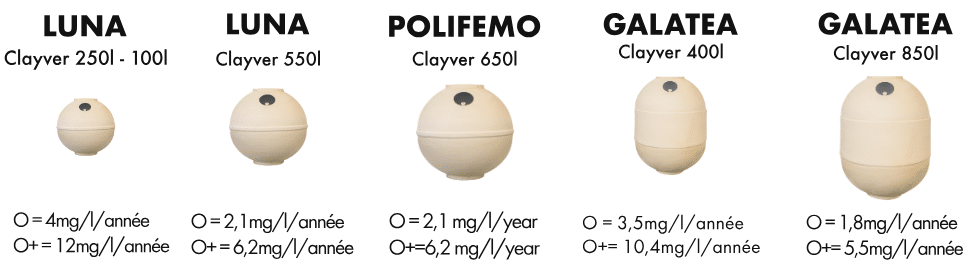
It has for some time been clear that the Micro-Oxygenation (Mox) – the transfer of oxygen through the vessel – is quite a lot lower in the Clayver vessels – but how much lower?
Now we have the full and correct numbers with the help of Clayver – thanks a lot. The people of Clayver in France and Italy are always very helpful
The Micro-oxygenation
| The vessel breathes moderately, without excess, to best preserve the wine. The micro-oxygenation is steady, gentle, and consistent. (Clayver). |
Clayver prefers using the wording “oxygenation” as the more accurate term. The ceramic allows a controlled and beneficial oxygen exchange that helps the wine evolve harmoniously. The term “oxidation” may sometimes suggest an undesirable wine fault caused by excessive oxygen exposure, which is not the effect sought or observed with Clayver. I understand … but no wine without oxygen, so to speak.
| Comparison of vessels |
| New Oak barrel normal size = 20 to 40 mg/L/year |
| 1-2 wine Oak barrel normal size = 15 to 25 mg/L/year |
| 3-4 wine Oak barrel normal size = 10 to 15 mg/L/year |
| Clayver Luna 250L O = 4 mg/L/year – low oxidation |
| Clayver Luna 250L O+ = 12 mg/L/year – high oxidation |
| Clayver Galatea 850L O = 1.8 mg/L/year |
| Clayver Galatea 850L O = 5.5 mg/L/year |
So in reality, quite a large difference in oxidation between the different Clayver barrels.
Clayver ceramic is made from a specific, homogeneous, and patented blend. This allows the porosity of the material to be precisely adjusted through the firing temperature, thanks to the transformation of silica into glass.
Using the same principle, and with the addition of a silica-based coating, it is also possible to vitrify the ceramic completely, eliminating any oxygen transfer. In this case, the vessel behaves like glass while still providing thermal insulation and protection from light-strike effects. This solution is widely used in Champagne for the storage and ageing of reserve wines.
You need to login as a Premium subscriber to read the rest of this article. If you are not a Premium Subscriber, use the subscribe function and sign-up.
 - A true vin d’émotion – a Burgundy of passion
 - A truly hedonistic wine – lively and enjoyable
 - A vivacious wine for pure indulgance
 - A potential vin d´émotion - frais et léger